Flexible labour markets
What are flexible labour markets?
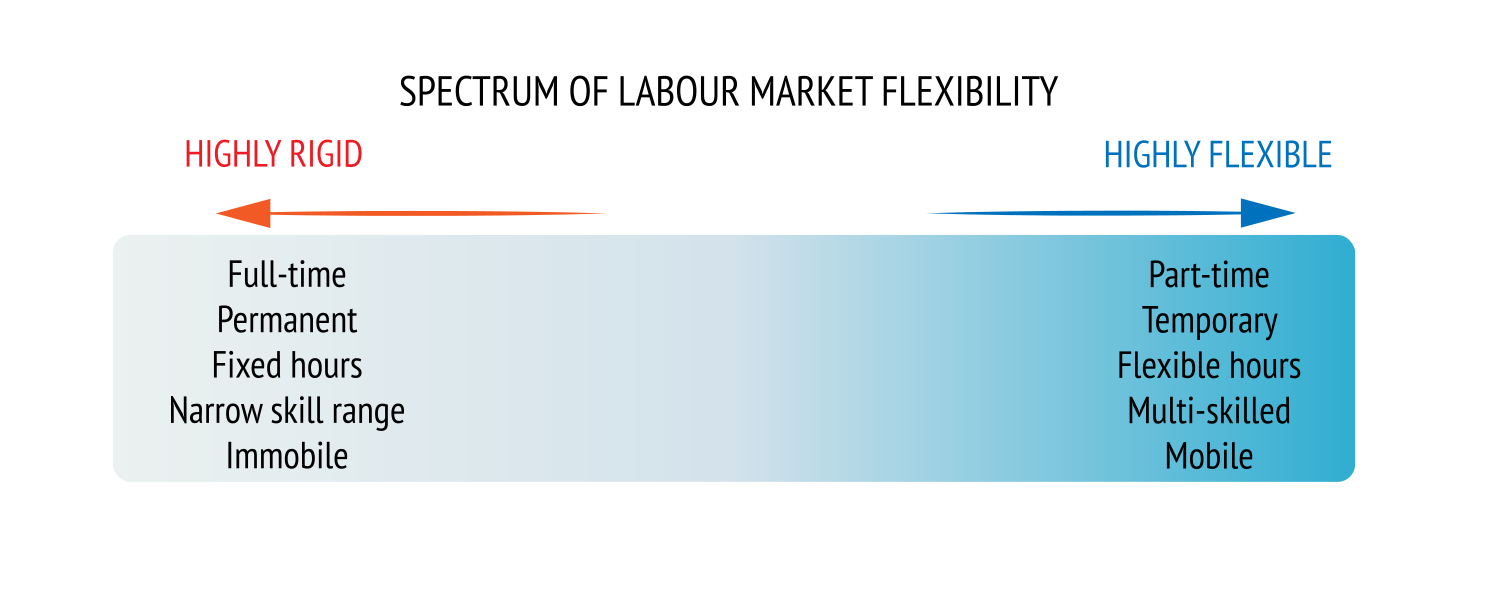
While there is no single characteristic that defines a labour market as flexible, the following characteristics increase the flexibility of labour markets:
Characteristics of a flexible labour market
- Workers have a wide range of skills which enables them to undertake a variety of jobs.
- Hours of work can be adjusted to suit the changing needs of employers.
- Jobs can be both part-time and full time - and workers are prepared to move between part-time and full-time.
- Workers may work on a temporary basic.
- Workers may supply their labour on a 'self-employed' basis.
- There is easy access into the market and exit from it - businesses have the ability to hire and fire as they wish.
- Workers are geographically and occupationally mobile and are prepared to move to where they are needed.
Benefits of flexible labour market
- Firms can keep their labour costs under control.
- This may allow firms to reduce their prices, which may increase consumer surplus.
- Firms can quickly adjust their employment to suit changes in the demand for their products.
- The supply of labour is more elastic, which means wages can be kept down and employment increased.
- Many workers may gain from flexibility because they do not want full-time and permanent employment or they prefer to work for several employers.
- Firms may be more competitive as they can adjust to changes in market conditions.
- From a macroeconomic perspective, unemployment may be reduced as workers are more employable - flexibility allows markets to 'clear' more quickly, with excess full-time labour being employed on part-time or temporary contracts.
- Aggregate supply may be more flexible, increasing the overall level of competitiveness. Increasing the flexibility of the labour market is a part of supply-side policy.
- This may help improve trade prospects and improve the balance of payments and prospects of economic growth.
- An economy with a flexible labour market is more likely to receive foreign direct investment.
Disadvantages of flexible labour market
- The biggest criticism of labour market flexibility is that it is likely to increase the insecurity of workers.
- Part-time workers may be less motivated and less loyal and committed to their employers.
- Workers may not develop skills in comparison with full-time and permanent employees, leading to a skills gap.
- Workers on temporary contracts may not be able to save for retirement, or benefit from company pension schemes.
- Supporters of dual labour market theory argue that flexibility can widen the income gap between those in the primary labour market (full-time and permanent employees) and those the secondary labour market (make up of part-time and temporary employees).
- Workers may suffer from higher costs of searching for work, including the time taken to search and transport costs to attend interviews (as well as additional costs of moving between different jobs).