Employment and unemployment
Components of the labour force
A country's labour force includes those who are able to work and are either employed, self-employed or unemployed.
The labour force consists of the who are of working age (over 16 and under 65) less those who are in full-time education.
The size of the labour force is determined by a country's birth rate, its retirement age and those in full-time education.
Two rates (ratios) are important:
- The participation rate - which shows the proportion of a given group in the working population who are participating in the labour market. Typical rates to measure are: the female participation rate, or more generally the gender participation rate, and the rate for ethnic groups.
- The dependency ratio - which shows the ratio of dependents (under 16 and over 65) to those of working age (between 16 and 65) - Dependents/Workforce.
Labour productivity
Productivity refers to the output produced by a given quantity of factors of production.
The productivity of labour can be measured in three basic ways:
- Output per worker.
- Output per hour worked.
- Output per job.
Output per hour worked is often the preferred measure of productivity for international comparisons as it strips out the effects of variations in working hours, which can be quite considerable. For example, workers in Norway, Denmark and Germany work around 27 hours per week, compared with those in Russia, Chile and Greece who work around 10 hours more per week. [1]
Productivity can also be measured in terms of total productivity, average productivity, and marginal productivity (the additional output contributed by the marginal worker.)
In the hypothetical table, workers are added to a fixed factor (a plant or factory) and their output is recorded.

While total output (total product) increases, it does so at a decreasing rate. It is more useful to look at average product and marginal product as this can highlight changes in productivity more directly.
Economic theory predicts that average and marginal productivity will at first increase as workers can share out tasks more efficiently and take advantage of a division of labour. However, at some point diminishing returns will begin (with the addition of a third worker), as the possibility of specialising decreases and roles start to overlap.
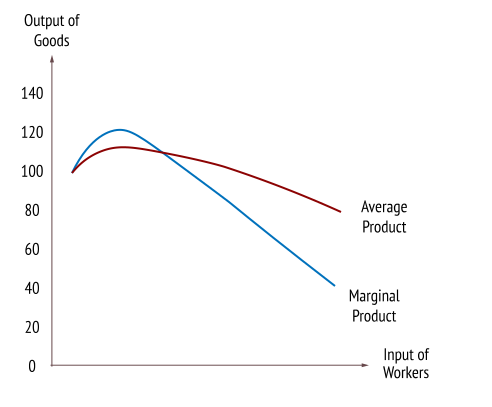
Of course, productivity can be improved with the addition of new machinery and technology, or with better training, and work practices.
Factors that improve labour productivity
Improvements in productivity can arise from:
- New working practices
- Improvements in education and skills
- Application of new technology - technological progress
- An increase in the quantity and quality of capital investment in an economy
Impact of improvements in labour productivity
Improvements in labour productivity can have a range of effects across the economy, including both micro and macro economic effects:
- An increase in demand for labour - graphically, the demand for labour curve shifts to the right
- Productivity linked wage increases - wage bargaining may be based on productivity improvements
- Reduced unit costs
- Increased profits for firms
- Less pressure on prices - and, hence less inflationary pressure at the macroeconomic level
- Improved aggregate supply - long run aggregate supply is affected by labour productivity
- Increased international competitiveness
- Helps improve trade and the balance of payments
- Better prospects of economic growth in the long run - growth in the long run is highly dependent on labour productivity
Full employment and the natural rate of unemployment
Full employment as an objective
In simple terms, 'full' employment means that all those who are willing and able to work are gainfully employed.
However, full employment does not mean 'zero' unemployment, given that some people of working age choose not to work, and some are temporarily out of work for a variety of reasons, such as changing jobs. While there is no definitive target for 'full employment', policymakers tend to assume that when unemployment approaches 4%, full employment is reached.
The natural rate of unemployment
The natural rate of unemployment (NRU) refers to the amount of unemployment that exists in an economy when the labour market is in equilibrium.
Hence, the NRU is a microeconomic concept that attempts to explain the macroeconomic problem of being unable to achieve full employment. The NRU is a similar concept to NAIRU, which stands for the Non-Accelerating Inflation Rate of Unemployment. (see NAIRU)
Supporters of natural rate theory [1] also suggest that trade union power and the minimum wage prevent labour markets from clearing quickly, which adds to the NRU.
The 'gap' at any one time between the labour force and the effective supply of labour is the natural level of unemployment, and the natural rate is expressed as a percentage of the labour force. For example, for country X, the labour force might be 80m, and the effective labour supply is 75m, making an NRU of 6.25%.
We can see this graphically:

Here we can see that the market wage rate for the whole labour market is at W, where the demand for labour equals the effective supply. At this rate, the amount of labour employed is Es. However, there are still some unemployed, shown at the gap between E5 and Lf, which is the natural level of unemployment, which is made up largely of rigidities and imperfections.
Criticisms
There are several criticisms of NRU theory, the main ones being:
- Unlike traditional measures of unemployment, such as those claiming to be unemployed and seeking benefits, the 'natural rate' is not directly observable.
- This means it is not particularly useful for policy purposes, because if it cannot be observed then it cannot be targeted. This is unlike the similar concept of NAIRU - the non-accelerating-inflation rate of unemployment. While NAIRU is not directly observable the use of statistical models can provide an unemployment rate which is useful for policy purposes.
[1] Natural rate theory was developed by American economists, Milton Friedman and Edmund Phelps in the late 1960s and is associated with the monetarist and New Classical schools of economic thought.
Causes of unemployment
The causes of unemployment can be placed into two main categories - unemployment resulting from insufficient demand for labour and resulting from 'over-priced' labour. These can be extended by looking at 'types' of unemployment (see below).
Lack of demand - cyclical unemployment
Cyclical unemployment (also called 'demand deficient' and 'Keynesian' unemployment) arises when the economic cycle goes into a downturn, and where falling demand for goods and services leads to falling demand for labour.
Given that the demand for labour is derived from the demand for goods and services, a fall in aggregate demand means that fewer goods and services are in demand and less labour is required - causing cyclical unemployment.
Diagrammatically, a fall in aggregate demand (AD) can result in less output (at Y1 in the diagram below) and higher unemployment (at U1).
Assuming the output in the economy is initially at Y, a sustained fall in AD will result in less output - at a lower level of output fewer workers are required.

The result is cyclical or demand deficient unemployment.
Factors affecting cyclical unemployment
The extent of demand deficient unemployment depends upon the extent of the decline in aggregate demand as well as the elasticity of aggregate supply.

A fall in AD could result from a decline in any component, including a fall in consumption, investment, government spending or net exports.
Even a small fall is likely to be amplified by a downward multiplier effect as those workers initially unemployed spend less, which reduces income for others leading to even further unemployment.
Demand deficient unemployment in the UK
Like many advanced economies, the UK has experienced periods of demand deficient unemployment - notably the 1920s and 1930s, the recessions of the early 1980s and 1990s, and again during the financial crash of 2008 to 2010.
As yet, the effects of the Covid-19 pandemic remain unknown, but estimates put the unemployment rate for 2020 at 9% then falling back to 6% in 2021.
These estimates would have been much higher were it not for the UK's furlough scheme, which is set to run until at least the summer of 2021.

Excessive wages (or 'classical') unemployment
Real wage unemployment (or classical unemployment) relates to the effect of a sustained increase in real wages above the free market equilibrium wage rate.
Real wage unemployment may arise when free markets are prevented from establishing a market clearing equilibrium, including the following circumstances:
- Trade unions bargaining for wage increases in above of market equilibrium.
- Governments setting minimum wages.
- General deflation, with falling prices but where wages do not adjust downwards (they are 'sticky').
An increase in real wages will affect both the demand for, and supply of labour.

An increase in real wages (at W1) will cause the demand for labour to contract (a to b) and the supply to extend (a to c). This is the Classical theory of unemployment - if real wages rise above the market rate, fewer will be employed, though more will look for work.

A minimum wage would cause real wage unemployment if set above the market rate.
Elasticity of demand
The extent of real wage unemployment depends upon the elasticity of demand for labour, and on the elasticity of supply of labour. With a more elastic supply of labour (as with S1) as a result of lower skills or fewer barriers to entry, the impact of higher wages is significant in encouraging low skilled workers to join the labour market, hence increasing real wage unemployment. [real wage unemployment is now b to e.]

Also, if demand for labour is elastic, (as with D1) perhaps due to the ease with which capital can be substituted for labour, the contraction of demand may have a significant effect on the amount of surplus labour created. [Real wage unemployment is now c to f.]
If both demand for labour and the supply of labour is elastic, then there is a large potential increase in real wage unemployment.
Criticisms
Critics of this theory suggest that if we follow the logic then it can be argued that reducing unemployment can be successfully achieved by reducing wages back to the theoretical market clearing rate.
However, there are at least two objections to this:
- Firstly, reducing wage rates maybe be difficult to achieve in practice
- Secondly, reducing wages is likely to lead to falling spending, and a reduction in economic activity, with less employment (rather than more!)
Other criticisms include:
Free markets do not always arrive at the socially optimal level of employment and wages, such as where monopsonists are free to set low wages and employment, or where imperfect information exists in the labour market.
Finally, market forces do not necessarily operate in the public sector, where wages are set by government or government controlled pay-settlement organisations. In other words there is not an equivalent free market equilibrium wage rate against which to make a comparison.
The consequences of unemployment

The achievement of full employment is a key macro-economic policy objective because unemployment can create significant costs to individuals, families, businesses, and the whole economy. The severity of the costs depends upon the level and rate of unemployment, and whether it is temporary or longer term.
Unemployment of all types creates a range of costs to those involved, and to others.
Costs to the individual
Loss of income and living standard
Employment is the major source of income for most individuals, so being unemployed results in a fall in income, and a loss of living standard. Of course, welfare payments provide some level of support, but are unlikely to be generous as this can create a disincentive to seek work.
Loss of skills and worsening employment prospects
As skills depreciate, individuals may become trapped in an extended period of ‘long term’ unemployment. The loss of work-based skills reduces an individual’s employability in the future. When applying for new jobs, periods of unemployment will be revealed in an individual’s resume (CV). With imperfect knowledge of the reason for unemployment potential employers may make certain assumptions about the quality of the applicant, and rightly or wrongly, not call them forward for interview.
The unemployment trap
Some unemployed individuals may become dependent on welfare and increasingly trapped in unemployment. In this sense, welfare payments could be said to create moral hazard where out-of-work benefits are seen as an insurance against unemployment, but perversely increase the likelihood of remaining unemployed.
Reduced health
The unemployed are more likely to suffer from poor physical and mental health. This, in turn, increases the probability of remaining unemployed.
Costs to the family and children
Likelihood of poverty
An unemployed ‘breadwinner’ will mean that family income falls, which could push individuals below the poverty line. Poverty is clearly a major cost of unemployment, and once pushed into poverty individuals can be trapped there – the so called ‘poverty trap’.
Costs to the economy
There are significant costs of unemployment for the wider economy, including:
Opportunity cost
Every individual that is not employed creates an opportunity cost to society. The opportunity cost is the lost output that could have been produced if the unemployed had worked.
Waste of resources
An economy uses scarce resources to educate and train individuals as they progress from childhood to adulthood and into the labour market. If individuals become or remain unemployed then these resources have been wasted – if only temporarily.
Erosion of human capital
Human capital is the total stock of human resources existing in an economy, including the quality and skills of labour. Given that many important skills are gained while at work, unemployment can mean that new skills may not be acquired, and existing ones eroded – hence a depreciation in human capital.
Inefficiency
When an economy is fully using all its scarce resources it is said to be operating on the edge of its production possibility frontier (curve, or boundary), which indicates that the economy is operating at an efficient level.
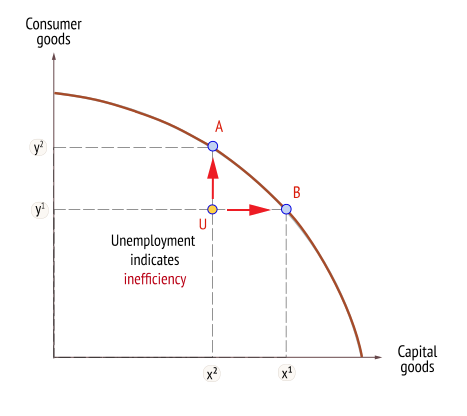
Unemployment signifies that the economy is not operating at an optimal level.
Loss of government revenue
Given that the unemployed have reduced levels of income, and are likely to spend less on a range of normal goods, less revenue will go the government both in terms of lower income tax and indirect tax receipts. This direct effect is accompanied with an indirect multiplier effect, where lower spending causes less income for others, and falling tax receipts.
Additional public spending
However, at the same time, government is likely to have to spend more on welfare support for the unemployed. If this cannot be raised through taxation, then the public sector will have to increase its borrowing – as happened in dramatic fashion because of the pandemic.
Loss of revenue and profits to firms
Like the government, some firms will also experience a fall in potential revenue from falling sales, which is also likely to lead to falling profits for producers. The downturn in profits is also likely to feedback into a fall in demand for labour, and increase the probability of more unemployment.
Unemployment may become embedded
Unlike episodes of inflation, unemployment may not be temporary, and can become embedded in an economy as workers displaced from the labour market become long-term unemployed. This creates a ‘deadweight’ loss to the economy.
Unemployment rates can continue to rise even when the initial cause of unemployment has ceased to exist. The tendency for unemployment to continue to rise is called ‘hysteresis’ – a term first used by the 19th Century Scottish physicist, Sir James Erving.
The clear conclusion from this is that unemployment imposes a considerable range costs to individuals, firms, and society, and that reducing unemployment should be a high priority for policy makers.
Are there any benefits to unemployment?
There is a long held view, associated with 'Classical' economics, that some unemployment is functional.
For example, 'slack' in the labour market with a pool of unemployed labour provides benefits to firms in terms of having increased choice of who to employ, and in containing wage inflation. This, in turn can reduce price inflation and make an economy more competitive in international markets.
The longer-term effect of this is that new jobs may be created with unemployment eventually falling. The Phillips curve clearly indicates that, at high levels of unemployment, inflation is likely to fall.
However, most economists agree that, despite the benefits of unemployment, they are greatly outweighed by the costs, and full employment (or at least maximum employment) remains a key macroeconomic policy objective.
See natural rate of unemployment
Types of unemployment
As well as demand deficiency and excessive real wages, there are several other types of unemployment, including:
Frictional unemployment
Frictional unemployment is a short term, temporary type of unemployment which occurs when individuals change their jobs. As such, frictional unemployment is regarded as a minor type of unemployment in comparison with structural or cyclical unemployment.
Examples
Individuals can be frictionally unemployed for a variety of reasons, including:
- Voluntary redundancies, where individuals leave a job because that job no longer exists - perhaps as a result of the business restructuring.
- New graduates who are searching for their first employment.
- Individuals who have recently migrated from abroad, and have the appropriate work visa, but have not yet found work.
- Some individuals will be relocating - perhaps as a result of marriage (or divorce) and are looking for work. While many will move seamlessly between jobs, some will remain jobless for a short time.
- Individuals leaving a job because they have been offered a better one, but where the start date does not coincide with the date the left their previous employment.
- Individuals who have previously left the labour market (perhaps to have a family, or to care for others), but are now looking to re-join, and are searching for work.
Structural unemployment
Structural unemployment occurs as a result of the changing structure of an economy over time and is defined as the unemployment resulting from a persistent mismatch between the demand for, and supply of, labour.
Although not the result of a lack of total demand, structural unemployment exists because the current ‘effective’ demand for labour is not satisfied by the current ‘effective’ supply of labour. Structural unemployment is regarded as a significant economic problem as it indicates the extent of unused labour.
The causes of structural unemployment
There are several causes of structural unemployment, including:
Changes in the pattern of demand
As incomes rise over time certain goods and services become more popular while others become less popular. Goods and services with a relatively high and positive income elasticity of demand experience increasing demand, whereas goods with low and negative income elasticity of demand do not see growth, or may even experience falling sales. Over time, these turn into declining industries.
From a macroeconomic perspective this creates a mismatch between the skills required in the emerging industries and those currently existing. Those who do not retrain or upgrade their skills may not be employable in the growth industries. Even if they do retrain this process takes time, and individuals may be structurally unemployed for an extended period of time.
Technological change
Developments in technology may force firms to substitute labour with capital. Firms look to recruit those with the skills needed to use new technology. In addition, new technology encourages the emergence of new firms who can exploit the opportunities that this new technology brings.
For example, the internet has dramatically changed how most firms operate, and the type of labour they recruit -creating new employment prospects for some, and reduced opportunities for others. The travel industry is a clear example of this, where online travel bookings now dominating the industry.
Rigidities in the labour market
Labour markets are not always flexible enough to help match the supply of labour to the demand. Barriers to entry into the labour market including unionisation, discrimination and excessive regulation, may deter entry into the market and restrict the ability of newly emerging industries to recruit the staff they need.
Globalisation
Globalisation and the opening up of economies to free trade has increased international trade and encouraged the exploitation of local comparative advantage.
The rise of China and India as manufacturing nations has meant that many jobs in western economies have been ‘exported’ to them, including jobs in light engineering, pharmaceuticals, and textile production.
Inefficiencies in the provision of education or training
Structural unemployment may worsen when education and training do not function efficiently. The quality of human capital is a key determinant of productivity and employability, but formal education may be unresponsive to the changing needs of the labour market.
Structural unemployment means that while job vacancies exist a lack of skills and the ‘education gap’ may explain why they are not easily filled. The ‘education and skills gap’ is likely to have a particularly large impact on youth employment, with younger workers joining the labour market with insufficient skills. The same is true with ‘re-employment’ after a recession or downturn.
Geographical immobility
Labour immobility is a significant element in structural unemployment. Structural change frequently has a regional dimension with declining industries existing in different regions than emerging and developing industries. The decline in the UK’s manufacturing base from the 1970s affected the north while the growing service sector was located in the south east.

Regional unemployment
Regional unemployment is a sub-category of structural unemployment. This occurs when job vacancies resulting from the expansion of an industry exist in one region, but workers have been displaced from declining industries located in a different region. For example, a decline in agricultural employment may result in displaced workers in rural areas who are unable or unwilling to get jobs in new industries in urban areas.
Technological unemployment
Technological unemployment arises when labour is displaced by new technology. This is more likely to affect older workers who may be unable or unwilling to adapt and re-skill to gain employment in industries which use new technology.
Voluntary and involuntary unemployment
One way to classify unemployment is to distinguish between voluntary and involuntary unemployment.
Voluntary unemployment
Voluntary unemployment refers to a situation where workers are able to work at the going real market wage rate but choose not to, perhaps just for a short period of time. [1]
This definition can be developed to include the concept of marginal productivity, as did Keynes [2] when he identified voluntary unemployment as a situation when a worker is unwilling to accept a reward that is equivalent to value of the marginal product they create. In other words, while pay reflects the value of marginal productivity, the worker - for whatever reason - does not want to accept that work.
Hence, frictional unemployment - where individuals are changing jobs or delaying taking a new job for a short period of time - is usually placed into the voluntary category of unemployment.
Involuntary unemployment
Involuntary unemployment is a situation where workers are willing and able to work at the going real market wage rate, but they cannot find work. This is a result of demand deficient unemployment (also called cyclical unemployment) caused by a downturn in the economic cycle.
During the downturn, workers leave the market, perhaps temporarily, as firms downsize or dissolve, and may re-join the labour market when the economy begins to grow - perhaps with a considerable time lag between changes in aggregate demand and the labour market.
Additional reading - Dual labour market theory
One way to explain voluntary unemployment is to distinguish between the primary and secondary labour market.
The primary labour market
The primary labour market generally involves permanent-type jobs, with nationally negotiated pay rates, with larger enterprises and organisations as the major employers, and where jobs tend to be full-time.
Workers tend to become attached to this market and look for long-term employment with a career ladder and promotional prospects. Pay in the primary labour market is relatively high, with jobs well designed, and where workers may be offered considerable training.
The secondary labour market
The secondary labour market is exactly the opposite, and involves temporary-type jobs, with locally set pay rates, with variable hours of work, and with small enterprises as the major employers. Workers are not attached to this market or to the firms that they temporarily work for, and often look for short-term employment without a career ladder or promotional prospects. Jobs in the secondary labour market tend to be lower paid and less well designed, with little training.
Dual markets and unemployment
The idea of a dual labour market is appealing because it can help clarify the difference between voluntary and involuntary unemployment.
Workers in the primary labour market are likely to be more 'choosier' in terms of what work they accept, and may prefer to remain jobless for a period of time if they leave one job (say because they realise that there are no promotional opportunities) in favour of one that does. They are prepared to wait a while to find a job that appeals to them. Workers in the primary labour market are more likely to be able to rely on savings while unemployed. Of course, involuntary unemployment is still likely in the primary sector, as a downturn or recession may cause job losses across the economy.
In the secondary labour market, employment is more fluid, and it is less likely that workers will be so 'choosy' in terms of what work they accept.
While there may still be voluntary unemployment in the secondary labour market, workers are more likely to accept lower pay, and remain voluntarily unemployed for just a short period of time.
Unemployment rate
The unemployment rate is the proportion of the working population who are not in work.
| Unemployment rate = | People out of work | x 100 |
| Working population |
The two basic ways that unemployment is measured are:
Those officially measured as unemployed using a survey
Most advanced economies use a standardised and internationally recognised measure of unemployment, which is based on a survey (the 'Labour Force Survey', and which takes its definition of unemployment from the Geneva based International Labour Organisation - ILO). Members of the EU are all required to use this standard definition, and most countries either adopt the definition, or modify it in minor ways.
For the Labour Force Survey, the unemployed are defined as:
Those individuals who do not have a job but have been actively looking for one in the four weeks previous to the measurement date, and who are available to work within two weeks of the measurement date.
The rate of unemployment, expressed as a percentage, is:
The proportion of the ‘economically active’ population who are jobless - that is, those who are in work, available for work and actively seeking work. The unemployment rate is NOT the proportion of the whole population, or the population of ‘working age’, who are unemployed.
The survey sample
The Labour Force Survey takes a sample from the whole population, (in the UK, some 40,000 households are included in the sample) who are then surveyed every three months - 20% of the sample is replaced each quarter [1].
Those claiming benefit
One way to measure unemployment is to record those who claim to be unemployed, and seek government welfare benefits, which in the UK includes Job Seeker's Allowance (JSA) and Universal Credit. In the UK, this measure is called the 'claimant count', and most countries track the number of individuals claiming some form of welfare support as a result of being unemployed. However, the majority of countries have switched over to using a more standardised calculation for unemployment.
Difficulties in measuring unemployment
Measuring unemployment and comparing the performance of national economies is difficult because different methods of measurement and data collection exist between countries.
Advantages and disadvantages of using the Labour Force Survey
Advantages
Although it is a survey, it is generally regarded as more accurate than the Claimant Count.
International comparisons are more valid as the definition is standardised.
Disadvantages
Like all surveys, the sample chosen might not be fully representative of the population.
Monthly estimates are not as accurate as the full, quarterly result, which means they must be revised when the quarterly figures are known.
Additional administrative resources are required - over and above those related to measuring and administering welfare claims.
Advantages and disadvantages of using the claimant count
Advantages
The data is recorded automatically through the benefits system when individuals make their claim.
Claimant data is relatively easy to access.
The concept is easily understood.
While not 'perfect' it can provide an indication of changing levels of unemployment.
Disadvantages
It may not be a very reliable indicator of unemployment as a result of frequent policy changes in terms of who is eligible for benefits. For example, the introduction of Universal Credit in the UK in 2013 changed the basis upon which claims could be made.
As noted, not all individuals who are looking for work can obtain welfare benefits, and hence are not included as a claimant.
It is not useful for international comparisons as different countries have different claimant requirements.
Individuals may claim, and indicate that they are available for work, but actually work in the 'hidden' economy for cash.
-
Some unemployed may not bother to register and claim benefit.
Both the Claimant Count and the Labour Force survey provide key information on the amount of slack in the labour market.
In the UK, the employment rate is around 75% of the 16 to 64-year-olds. Men have a slightly higher employment rate than women, at 78% and 72% respectively (as of February 2021).
Go to policies to correct unemployment