The determinants of demand
Definition of demand
In economics, 'effective' demand is the willingness and ability of consumers to purchase goods and services at particular prices in order to satisfy their wants and needs. Without the presence of both willingness and ability demand is not effective. Willingness to purchase requires the addition of purchasing power to make demand effective. This depends on consumer's having an income and a spending budget.
Individual and market demand
Individual demand is the demand for a good or service by an individual over a range of possible prices. Market demand is the sum of the demand by individuals over a range of prices.
Consumer demand is influenced by price, and a range of non-price factors.
Demand and price
The economist models demand, firstly, by using the ceteris paribus rule to hold all possible factors constant, and then varying a single factor - or determinant - to analyse the effect. The ceteris paribus rule is fundamental to analysing how variables are connected. The rule is always assumed but does not always need to be explicitly mentioned for every piece of analysis.
The starting point for the model of demand (and supply) is the price of a good or service. The quantity demanded at various prices can be mapped using a demand schedule.
Price and quantity demanded are usually inversely related - at lower prices consumers will consume more.
Example
The following market demand schedule shows how the quantity demanded for bottled water varies over a range of hypothetical prices (expressed in $'s). A demand curve is derived from the schedule.

Given that the relationship between quantity demanded and price is inverse, a demand curve is, typically, downward sloping. There are several explanations of the downward slope of a demand curve, including the role of the income and substitution effects, and the principle of diminishing marginal utility.
Extensions and contractions
A change in price will lead to a change in the quantity demanded, assuming other determinants remain constant. Graphically, an increase in price leads to a contraction back and upwards along the existing demand curve, and a decrease in price leads to an extension down and forward along the existing curve, as shown.

Non-price determinants
Non-price determinants of demand are all determinants other than price, and include:
- Consumer incomes - as incomes change consumers are likely to adjust their spending. For 'normal goods' the relationship between income and demand is positively related. However, for 'inferior goods' the relationship is inverse. The extent of the change depends upon the income elasticity of demand.
- Tastes, trends, fashion, and preferences - changes in preferences will mean that consumers switch their budget from goods and services that are less favoured to those that are more favoured. Consumer spending patterns can change from season to season, or as a result of changing fashions.
- Prices of substitute products - if we assume that the price of a particular good or service is held constant, a change in the price of substitutes is likely to cause a change in demand for the product under consideration. The extent of this response depends upon the cross elasticity of demand. The closer the goods are as substitutes for each other the larger the response.
- Prices of complementary products - many goods and services have utility because of the impact of other goods or services. For example, for many, adding cream to coffee increases the benefit of drinking coffee - cream 'complements' the coffee. Hence, a change in the price of cream may affect the demand for coffee. With complements, the relationship between price and quantity demanded is inverse - a rise in the price of cream is likely to lead to a fall in the demand for coffee. Of course, the effect may be very small indeed given that coffee and caffeine are addictive. Complementary goods are also called jointly demanded goods (see interrelated goods).
- Changes in demand for other goods - demand for some goods and services (especially commodities) is derived from the demand for other goods or services. For example, an increase in demand motor vehicles will lead to an increase in demand for steel.
- Weather and natural factors - changes in natural factors will change the demand for some goods and services. For example, an increase in the frequency of flooding in an area is likely to lead to an increase in the demand for special flooding insurance, and for materials which are used for flood defences.
- Expectations - changes in expectations can have a considerable impact on current demand. For example, an expectation that there may be a fuel (petrol/gasoline) shortage is likely to increase demand for fuel in the short run as motorists look to reduce the risk of not being able to use their vehicle. This can, of course, trigger further increases in demand and create the very shortage motorists feared.
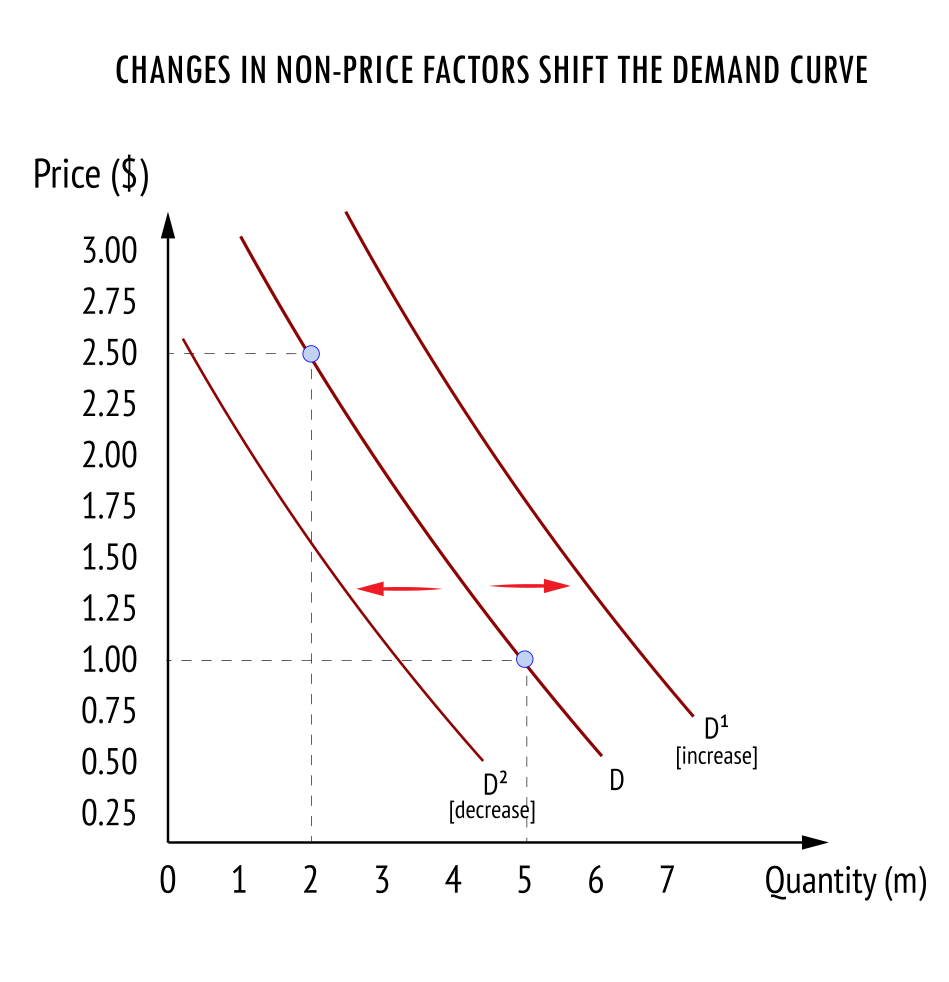
If any of these non-price determinants change, the position of the demand curve will change. An increase in demand will shift the demand curve to the right, and a decrease will shift it to the left. See below