


A minimum price
A minimum price sets the lowest level that a good or service can legally be sold for. The desired effect is that consumption of the good will fall, resulting in a welfare gain to society.
Why have a minimum price?
Setting a minimum price could be used in the following situations:
- When the good is a demerit good, such as alcohol or other drugs - a minimum price can help reduce demand.
- When there are information gaps, meaning that the consumer fails to perceive the impact of consumption on themselves - such as the long term impact on their health.
- If the good is non-renewable and is currently consumed at an unsustainable rate - a minimum price will restrict demand, and conserve resources.
- If the good or service is sold by below the market rate by a firm looking to gain an 'unfair' competitive advantage.
- The price of labour, its wage rate, may be supported by a minimum wage policy, which can help reduce 'poverty pay' and wage inequality. A minimum wage can also provide an injection of spending into the circular flow of income.
The minimum price diagram
Graphically, the effect of setting a minimum price is that demand contracts, from 'a' to ‘b’.
The contraction of demand can be explained through a negative income and substitution effect. An increase in price (assuming income remains constant) reduced real income (the income effect) and, assuming the price of substitutes remains constant, an increase in rice makes substitutes appear cheaper (the substitution effect).
Raising price to the minimum level also affects supply, which extends from 'a' to ‘c’. The reaction of producers to this is based on the effect of a price rise on expected revenue and profits. A higher price will act as an incentive to increase supply.
The effect of these two reactions is to create surplus of the good - from 'b' to 'c' (Q1 to Q2).
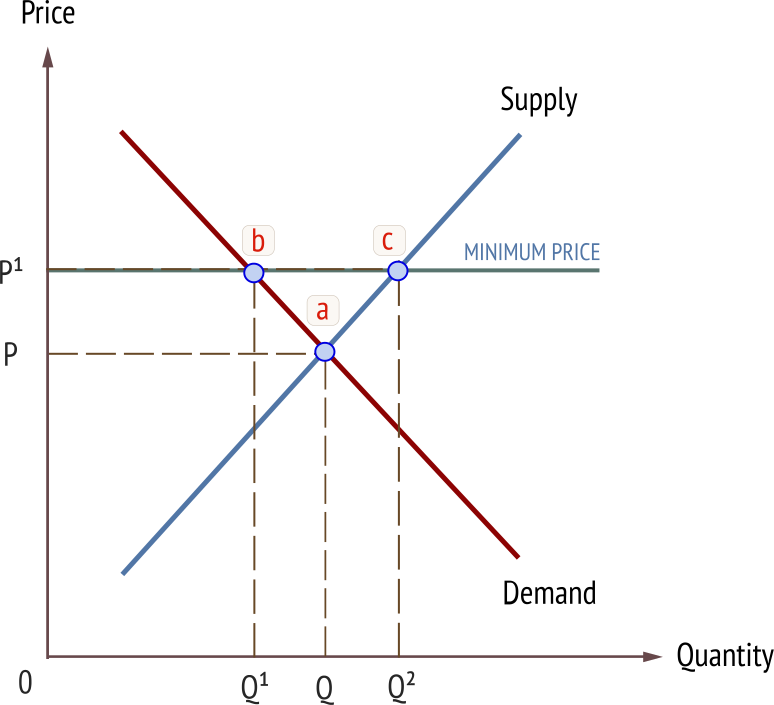
Of course, this reaction only happens if the minimum is set above the market rate. If it is set below, the market rate prevails.
Example
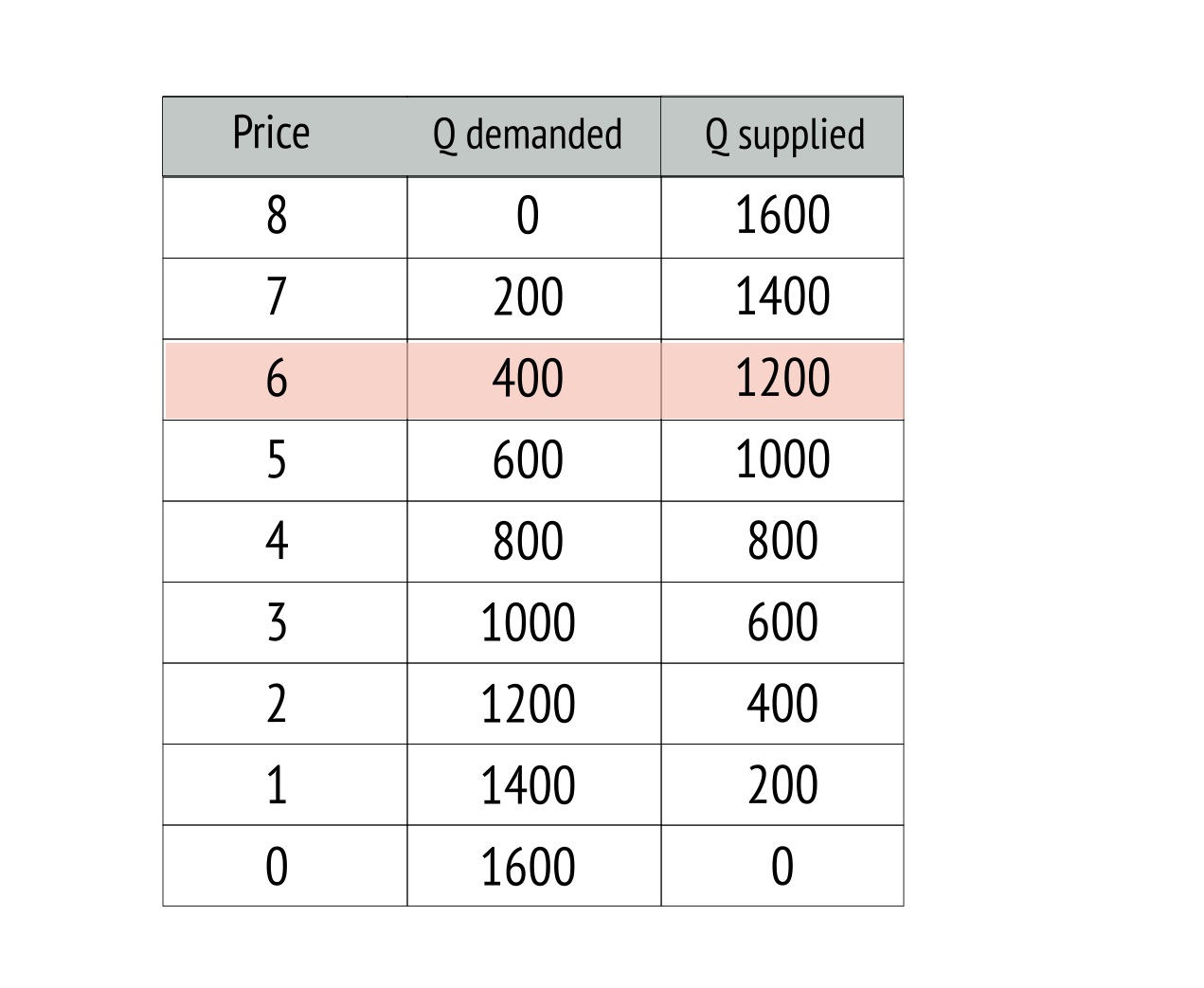
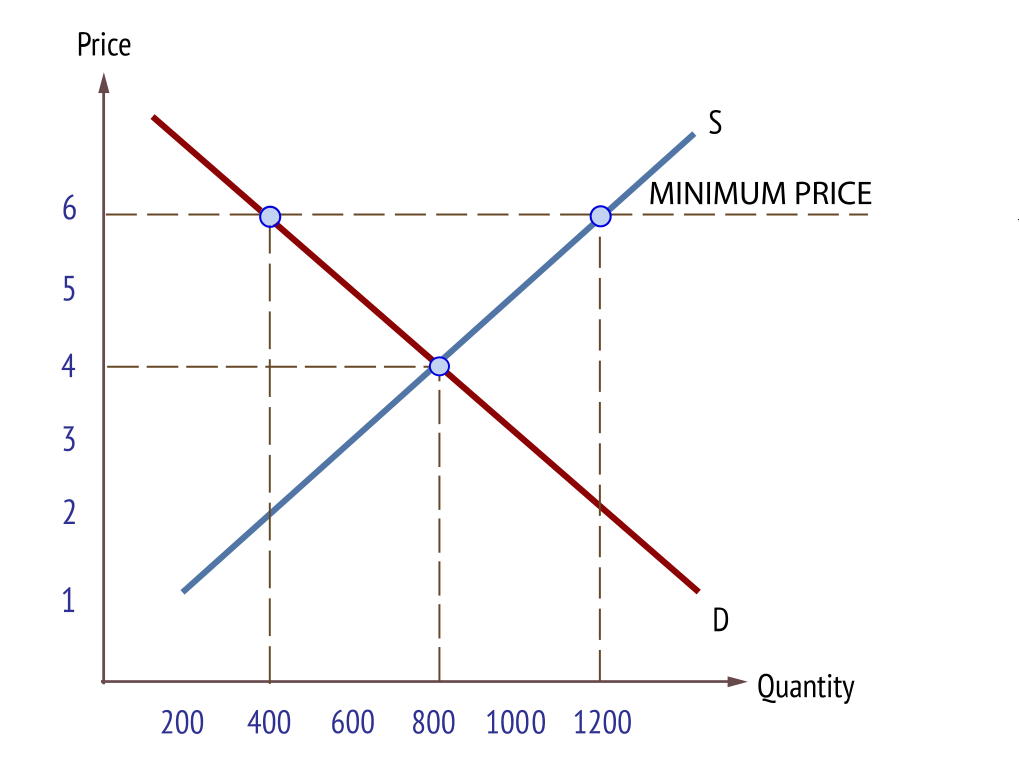
If we consider the following data on market demand and supply for an alcoholic drink, we can see that the free market equilibrium is at a price of 4 euros. If, however, a government sets a minimum price of 6 euros, then demand will contract from 800 units to 400. However, supply will extend to 1200, creating a surplus of 800 units.
The effect of price elasticity
The impact of a minimum price depends on the price elasticity of demand and supply, which, diagrammatically, alters the gradients of the demand and supply curves.

When consumers are unresponsive (inelastic) in terms of their response to a minimum price, the reduction in consumption will be relatively small. Similarly, when supply is inelastic, producers cannot increase production quickly, with the result that the surplus is small.
Evaluating a minimum price
- Clearly, with many demerit goods demand is relatively habitual, and consumers may well carry on consuming - hence the welfare gains may be modest.
- In comparison with a specific indirect tax, minimum prices generate no direct revenue to the government, although ad valorem taxes (percentage taxes, such as VAT) will increase as price increases.
- The impact of the minimum price is likely to be regressive, with a more significant impact on the 'poor'.
- Producers may suffer, with jobs lost in the industry and with resulting negative externalities.
- As with all types of government intervention there is the potential issue of information failure - governments are unlikely to set a minimum price that reduces consumption to the exact quantity that would achieve optimum levels of welfare.
- Finally, there is the possibility of some 'unintended consequences' of the policy - for example, some sellers may turn to the hidden economy to sell at below the legal minimum.


