


Legislation
In economics, legislation is an important tool of government to control the actions of consumers and producers, protect private property, and protect the environment against harmful externalities.
In simple terms, legislation can either target the consumer (the demand for goods and services) or producer (the suppliers of goods and services). Laws can be passed to deal with a variety of behaviours by these economic agents, including:
- Controlling the consumption of demerit goods, including licensing the sale of alcohol, age limits for drinking alcohol, restrictions on times of sale, limits on the alcoholic content of drinks, and on labelling.
- Making some demerit goods illegal, such as drugs classed as illegal.
- Controlling the sale and supply of certain pharmaceuticals that can only be provided through a doctor's prescription.
- Laws to protect the consumer against the unfair practices of businesses, such as price fixing and collusion.
- Laws to protects the environment, including the need for motor vehicles to have an MOT test.
- Forcing firms to label the contents of products.
These are just a few examples of how legislation can impact the demand and supply of goods and services.
The impact of legislation on the market
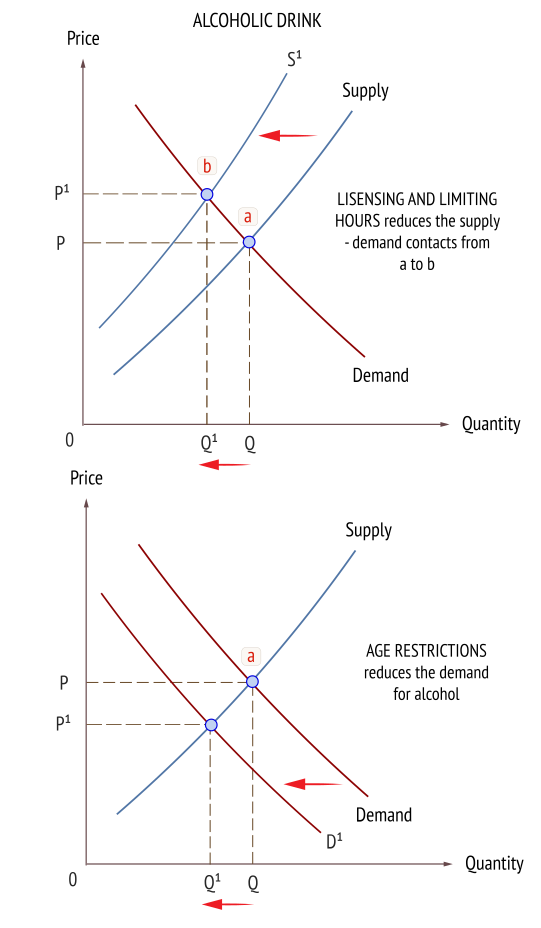
Legislation will either attempt to reduce the supply of a harmful demerit good, or reduce the demand. For example, licensing and controlling the hours that bars or restaurants are open will reduce the supply of alcoholic drinks (shifting the supply curve to S1 in the diagram below) and imposing age restrictions will reduce the potential demand for alcohol (shifting the demand curve to D1)
Weaknesses of legislation
The effectiveness of legislation depends upon how economic agents respond. This may not be to the extent that law makers hope, which may be determined by the size of any penalty and the changes of being caught.
The costs of enforcement may also be a concern. To prevent all illegal drug taking would be impossible given the costs of enforcement and the difficulty in recruiting sufficient police officers.
Economic incentives may be stronger than any penalty from legislation - the financial gains made by firms from collusion and market rigging may simply outweigh the penalties from being caught.