


The Marshall-Lerner condition
The Marshal-Lerner condition relates to the impact of a change in the value of a currency on a country's net exports, and the current account of the balance of payments.
A rise in the exchange rate will reduce import prices and increase export prices. However, the effect of this on import spending an export revenue is not certain. The impact of this depends upon the relative elasticity of imports and exports.
The Marshall-Lerner condition states that a change in the exchange rate of a currency will only impact on net trade flows if the price elasticities of imports and exports are greater than 1.0. We tend to assume that this condition is met, and hence a fall in the exchange rate will stimulate exports and constrain imports to the extent that net trade increases, and aggregate demand increases.
IIn the short run, domestic demand for imports and overseas demand for exports tends to be inelastic and show to respond to price changes. In this case, the Marshall-Lerner condition may not be satisfied.
However, in the longer run demand tends to adjust more to price changes, and the Marshall-Lerner condition may be satisfied.
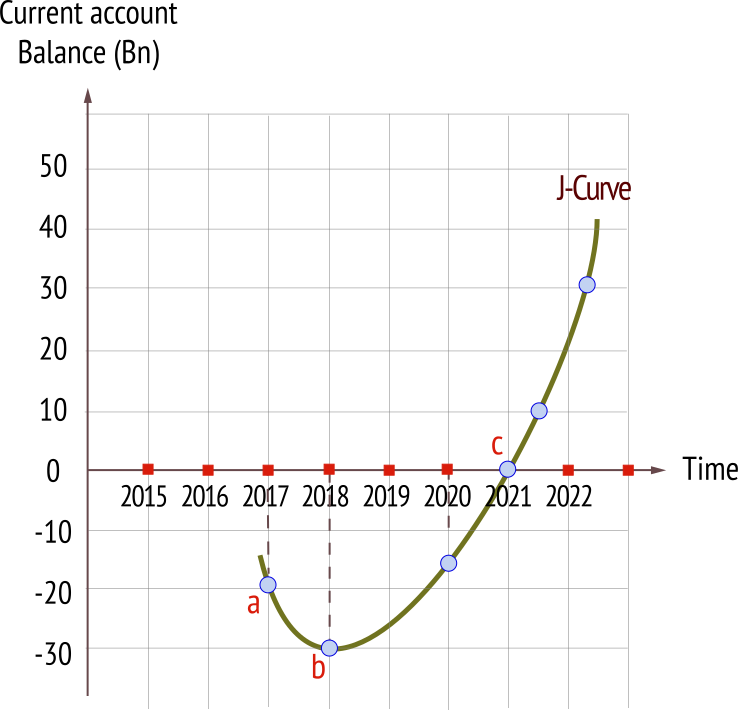
This explains the ‘J-curve’ path following a devaluation, indicating the Marshall-Lerner condition is not met in the short-run, and devaluation causes any trade deficit to worsen. In the graph, a devaluation during 2017 leads to a worsening of the current account in 2018. However, by 2021 a current account balance is achieved. The impact of this analysis on trade policy is to raise concerns about the effectiveness of a devaluation on the current account, suggesting that it is not a policy that works in the short-run - indeed, it may be counter-productive.
Although not conclusive, a good deal of research has been undertaken, which supports the general conclusion that, at least in the long-run, the Marshall-Learner conditions is satisfied (see research on exchange rates in India).
Other criticisms of devaluation
- Other countries may see a devaluation as an artificial attempt to gain a competitive advantage and devalue their own currency as a form of retaliation.
- While devaluation could stimulate export-led growth there is a danger of inflation - firstly because import prices will rise, and secondly as a result of economic growth.
- Devaluation could result in speculation against the currency that devalues if speculators feel that the new rate is not sufficiently low enough to have the desired policy effect.