


Production and productivity
Production
Production is the process of using scarce resources to create an output of goods and services. The resources used are called 'factors' of production, and include land, labour (or human capital), equipment, machinery and technology (real capital) and enterprise.
Some factors of production are fixed, which means they do not change as output increases or decreases, and some are variable, which means they do change as output changes. While machinery in a plant is a fixed factor, it does depreciate over time, and may have to replaced when needed.
Output that is produced and then taken to market is called 'supply'.
Productivity
Productivity refers to the output produced by a given quantity of factors of production.
Total factor productivity looks at the output from all factors, and labour productivity looks at the output from just labour.
Labour productivity
The productivity of labour can be measured in three basic ways:
- Output per worker.
- Output per hour worked.
- Output per job.
Output per hour worked is often the preferred measure of productivity for international comparisons as it strips out the effects of variations in working hours, which can be quite considerable. For example, workers in Norway, Denmark and Germany work around 27 hours per week, compared with those in Russia, Chile and Greece who work around 10 hours more per week. [1]
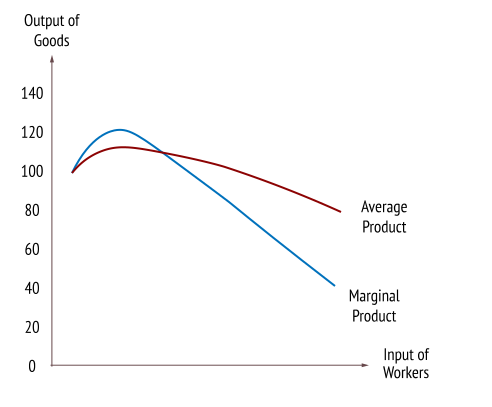
Productivity can also be measured in terms of total productivity, average productivity, and marginal productivity (the additional output contributed by the marginal worker.)
In the hypothetical table, workers are added to a fixed factor (a plant or factory) and their output is recorded.

While total output (total product) increases, it does so at a decreasing rate. It is more useful to look at average product and marginal product as this can highlight changes in productivity more directly.
Economic theory predicts that average and marginal productivity will at first increase as workers can share out tasks more efficiently and take advantage of a division of labour. However, at some point diminishing returns will begin (with the addition of a third worker), as the possibility of specialising decreases and roles start to overlap.
Of course, productivity can be improved with the addition of new machinery and technology, or with better training, and work practices.
Factors that improve labour productivity
Improvements in productivity can arise from:
- New working practices
- Improvements in education and skills
- Application of new technology - technological progress
- An increase in the quantity and quality of capital investment in an economy
Impact of improvements in labour productivity
Improvements in labour productivity can have a range of effects across the economy, including both micro and macro economic effects:
- An increase in demand for labour - graphically, the demand for labour curve shifts to the right
- Productivity linked wage increases - wage bargaining may be based on productivity improvements
- Reduced unit costs
- Increased profits for firms
- Less pressure on prices - and, hence less inflationary pressure at the macroeconomic level
- Improved aggregate supply - long run aggregate supply is affected by labour productivity
- Increased international competitiveness
- Helps improve trade and the balance of payments
- Better prospects of economic growth in the long run - growth in the long run is highly dependent on labour productivity