


Fiscal policy
What is fiscal policy?
Fiscal policy attempts to alter aggregate demand through taxation, government spending, and borrowing. Aggregate demand (AD) is composed of household spending (C), investment spending (I), government spending (G) and 'net exports' (exports, less imports, X - M).
Fiscal policies target particular components of aggregate demand in order to achieve specific policy objectives.
For example, if the policy objective is to stimulate economic growth, policy makers may reduce the basic rate of income tax to increase disposable income, which may then trigger an increase in household spending - the largest component of aggregate demand.
Budgetary positions
There are three basic budgetary positions which will have an impact on how fiscal policy will work, and whether there will be a stimulus to the economy, or not.
A balanced budget exists when government spending equals tax revenue (G=T).
A deficit budget means that government spending is greater than tax revenues (G>T) which will stimulate AD.
A budget surplus means that more tax revenue is collected than government spending in the economy (G<T). The effect of this is to control or restrict AD.
Fiscal policy can achieve both macroeconomic and macroeconomic objectives
Taxes and government spending can be used to help achieve both microeconomic and macroeconomic objectives.
Microeconomic objectives
Microeconomic objectives are generally related to reducing market failures, including:
- Controlling consumption of harmful products by increasing indirect taxation.
- Taxing negative externalities, such as carbon taxes.
- Using government spending to subsidise green technology.
- Spending on the provision of public and merit goods.
Macroeconomic objectives
Fiscal policy can influence aggregate demand by altering injections or withdrawals to:
Help control short term movements in the economic cycle, which can:
- Stabilise the price level.
- Help achieve employment.
- Promote economic growth.
- Ease balance of payments problems.
In addition, fiscal policy can also influence aggregate supply to:
- Promote long term growth through reducing direct tax rates and increasing incentives.
- Increase spending on education and training to improve productivity.
- Invest in national infrastructure projects.

How fiscal policy can influence aggregate demand
Fiscal policy can influence aggregate demand following one-off (discretionary) policy changes in government spending or taxation, or through changes in 'automatic stabilisers'.
Discretionary policy
Discretionary fiscal policy relates to the deliberate intervention by policy-makers to engineer a positive change in an economy - the intervention is 'at the discretion' of the policy maker taking into account the specific circumstances the economy faces at a particular point in time. For example, a rise in unemployment may trigger an increase in public spending through a 'one-off' policy change - usually in an annual budget. Assuming a positive multiplier effect, an injection of new government spending - say on infrastructure - will exert extra demand in the labour market, which is likely to reduce unemployment - assuming workers are willing and able to supply their labour.
A discretionary fiscal 'stimulus' - or fiscal 'brake' - is not 'built in' to the macro-economy, but requires deliberate decision-making in the face of specific economic circumstances. A fiscal stimulus means that the annual budget is moving towards an increased 'deficit' (or reduced surplus), when revenues from taxation are less than government spending, whereas a fiscal brake means that public finances are moving towards a 'surplus' (or reduced deficit).
Discretionary fiscal policy and unemployment
While supply-side policy has been the favoured policy option to reduce unemployment since the 1980s, fiscal policy was the preferred option for the majority of the 20th Century. Indeed, since Keynes, interventionist economists have argued that a fiscal stimulus is an effective way to reduce unemployment - this could involve reduced taxation, although an increase in public sector spending may have a more direct effect on job creation.
A fiscal stimulus will shift AD to the right, leading to economic growth (Y to Y1), and a fall in unemployment (U to U1). However, depending on the elasticity of aggregate supply, a fiscal stimulus will also put upward pressure on prices (P to P1).
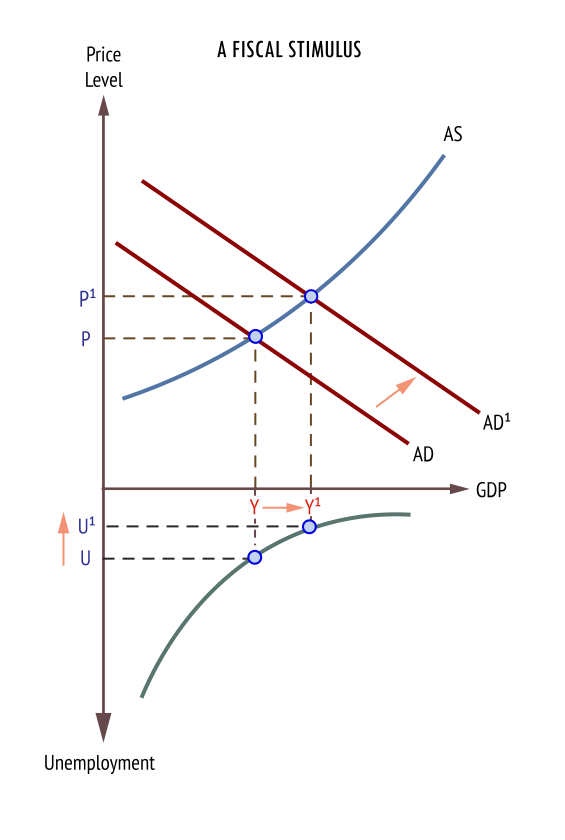
Critics would argue that jobs created his way may only result in a short term reduction in unemployment (see Phillips curve). In addition, a central feature of supply-side economics is the permanent reduction of marginal tax rates to create incentives to work (see the Laffer curve). This means that governments have become increasingly reluctant use discretionary tax policy to regulate the regulate aggregate demand.
Discretionary fiscal policy and the price level
While monetary policy is generally preferred to fiscal policy in terms of stabilising prices, changing tax rates or levels, and changing government spending may be used to supplement monetary policy at certain times. The options available are shown below:

Discretionary fiscal policy can be used to supplement automatic stabilisers when the trade (or business) cycle goes through more extreme periods than would normally be expected.
Automatic stabilisers
In contrast to discretionary policy, automatic stabilisers (often just called 'stabilisers') are 'built-in' to the tax-benefits system through the use of 'progressive' taxation and welfare benefits. Stabilisers are like a 'background app' running 'behind' the economy and automatically adjusting aggregate demand without any deliberate decision-making.
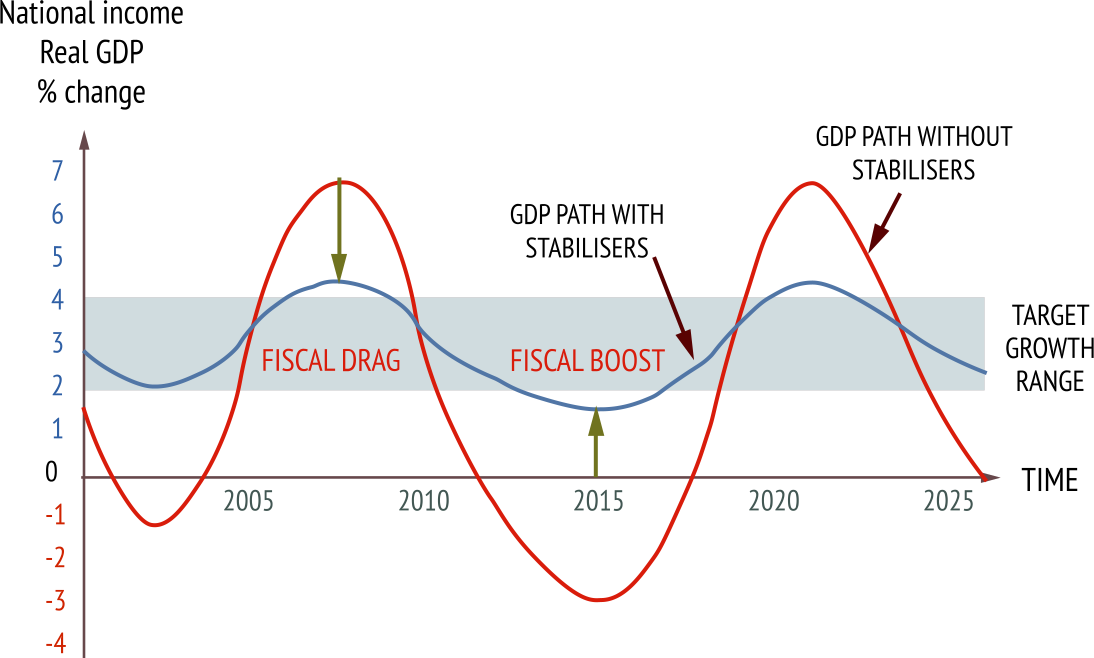
Stablisers work in two ways - either through ‘fiscal drag’ which slows down the economy, or through ‘fiscal boost’ which speeds it up - these two processes work to regulate the business cycle to avoid the extremes of activity which can lead to significant economic problems.
Fiscal drag
Fiscal drag means that progressive taxes and welfare benefits combine to slow an economy down if it is growing too quickly.
For example, if real incomes are increasing, all income earners will pay more given that income tax will be paid as a percentage of income. In addition, some income earners may move to a higher tax bracket (tax band) so that more of the extra 'original' income goes to the government in taxation. The combined effect of this is that the increase in income is dampened by the increased amount that is withdrawn from the economy in tax revenue.
At the same time, rising income means that some individuals now join the labour market, and receive an income. However, if they were already receiving income support in the form of welfare benefits, their income 'jumps up' by a smaller amount than if they received much lower welfare benefits.
This can be seen in the diagram below. The introduction of progressive income tax and welfare benefits moderates any increases in 'original income', and 'drags back' the growth in income in comparison with having no (or low) progression in the tax-benefits system.

Fiscal boost
Fiscal boost occurs when an economy slows down or goes into recession. Welfare benefits provide a 'safety net' and prevent the economy falling too far and hence avoid the worst effects of falling income.
Welfare benefits are an injection into the economy, and reduce the negative impact of lower economic activity. Also, as incomes fall, individuals pay less tax (and there is a smaller leakage from the circular flow) and this helps them retain more of their own income - boosting the economy at a time of lower growth, or recession.
In recent years more emphasis has been placed on the use of fiscal policy - mainly as a result of the weak effect of monetary policy when interest rates are at a virtual zero.
This is especially true in recent months following the Covid-19 pandemic when a fiscal stimulus is more appropriate than a monetary stimulus. In late March 2020 the US Senate approved a stimulus package of around $2 trillion, while in April Japan agreed an $1 trillion stimulus package and India agreed a $260 billion package. In the face of a crisis such as the Covid pandemic, monetary policy may have little effect, and supply-side policy will take too long to have an impact - hence a fiscal stimulus has clear advantages over possible alternatives.
Distinction between a fiscal deficit and the national debt
A fiscal deficit is the deficit that the public sector accrues during one financial year as a result of current and capital expenditure being greater than revenue from all sources.
A fiscal surplus arises when annual revenue is greater than expenditure.
A country’s national debt is the cumulative amount of debt that a country owes to national creditors.
Fiscal deficits will add to the national debt and fiscal surpluses will reduce the national debt.
Distinction between structural and cyclical deficits
Public finances will change over the business cycle, with finances moving toward a deficit when the economy is slowing down or going into recession, and moving towards a surplus when the economy grows.
Automatic stabilizers moderate the upward and downward effect of the business cycle.
Cyclical deficits
A cyclical deficit is likely to occur in the downturn and recession phase of the business cycle. In this phase, tax receipts from income (from direct and indirect tax) start to decline, while expenditure on welfare transfers and benefits start to rise.
As a fiscal boost starts to work, the economy will return to growth, and tax receipts again start to rise and government expenditures start to fall – at least this is the simple theory of cyclical deficits and surpluses.
Over time they should start to even out.
However, it is possible (and more likely for many economies) that a cyclical balance is not achieved.
Structural deficits
When an economy has a permanent fiscal deficit it is said to have a structural deficit.
This is significantly worse than a cyclical deficit in that there is a permanent gap between revenue and spending.
This can be dealt with by trying to change the fundamental structure of public finances, including cutting back on public spending or on increasing existing taxes, or from introducing new taxes. Of course, relying on borrowing is possible if repayments are sustainable.
Each of these has risks attached.
Permanently cutting back on spending has political and economic risks in that it is possible that cutting back on spending creates a period of austerity, falling standards of living, rising inequality and poverty, and austerity leads to falling tax revenues in the future which could worsen public finances.
Increasing taxes can create a disincentive effect of work and effort, and result in FDI being switched to another country. It may also create an environment where tax avoidance is seen as a rational option, and, in some developing countries, may increase the size of the hidden economy – thereby leading to a reduction in tax revenues in the future – a significant unintended consequence of the policy.
The final option is to borrow more, but there are significant risks associated with this, including the loss of creditworthiness if borrowing becomes significant.
A country’s credit rating may be downgraded, with increases in the cost of borrowing further down the line.
Borrowing is also potentially inflationary if borrowing is from the money markets, because issuing government debt through treasury bills is potentially adding to the money supply.
Of course, borrowing will need to be paid back, which can create an increased tax burden on future generations.
Factors influencing the size of fiscal deficits
Fiscal deficits are influenced by several factors, including:
- The 'position' of the economy in its business cycle - in other words, the growth rate in the economy.
- Tax rates, including marginal tax rates - higher marginal tax rates will act as a shock absorber against excessive economic growth, and welfare benefits will prevent recessions becoming too deep and prolonged.
- Government spending plans, including specific spending projects such as infrastructure improvements.
- The extent of tax evasion and tax avoidance.
- Tax loopholes may mean a loss of potential tax revenue.
- Capital flight, with a loss of beneficial investment resources causes a potential loss of revenue from capital gains.
- Interest payments accruing from national debts.
Factors influencing the size of national debts
Many of the factors that contribute to deficits clearly contribute to cumulative deficits and hence the national debt.
In addition to those factors are:
- Low savings ratios, which mean that tax revenues are relatively small.
- The structure of the population can also affect debt – for example, a high birth and a low death rate puts pressure on healthcare services for an extended period of time, with tax revenues insufficient to pay for these services.
- The level of development of the country – countries with low development levels may not be able to collect enough tax revenue to spend on projects that will improve development in the future, such as spending on infrastructure projects. This may force them into borrowing, which raises debt levels.
- The cost of servicing debt – many developing countries have a considerable debt and hence cost of serving that debt (the debt interest) can add further to the debt. Unless debts are rescheduled or written off, the national debt for many countries will simply continue to rise. The effect of any national disasters or military conflicts - some of which may be supported through aid, but some may be supported by borrowing.
The significance of the size of fiscal deficits and national debts
A large debt burden can have the following effects:
- It creates a burden for future generations, which means that they may have to cope with higher tax payments or fewer public services.
- Debt can be inflationary if it is funded by borrowing from the money markets. If government debt is funded by selling debt to the banks, it adds to the money supply. This is because short term debt is sold through Treasury Bills which the banks can consider as highly liquid and 'near to cash'. So for every unit of currency sold to the banks there is one more unit it of currency in the money supply.
- Rising debt can increase financial and resource crowding out, which raises long term interest rates and stifled the private sector.
- The 'pain' of policy which attempts to reduce debt burdens, including the 'austerity economics' of public sector cutbacks and tight fiscal controls.